
The Agentic Enterprise, Part 3
From Pilots to Production: Identity, Guardrails, and Scale

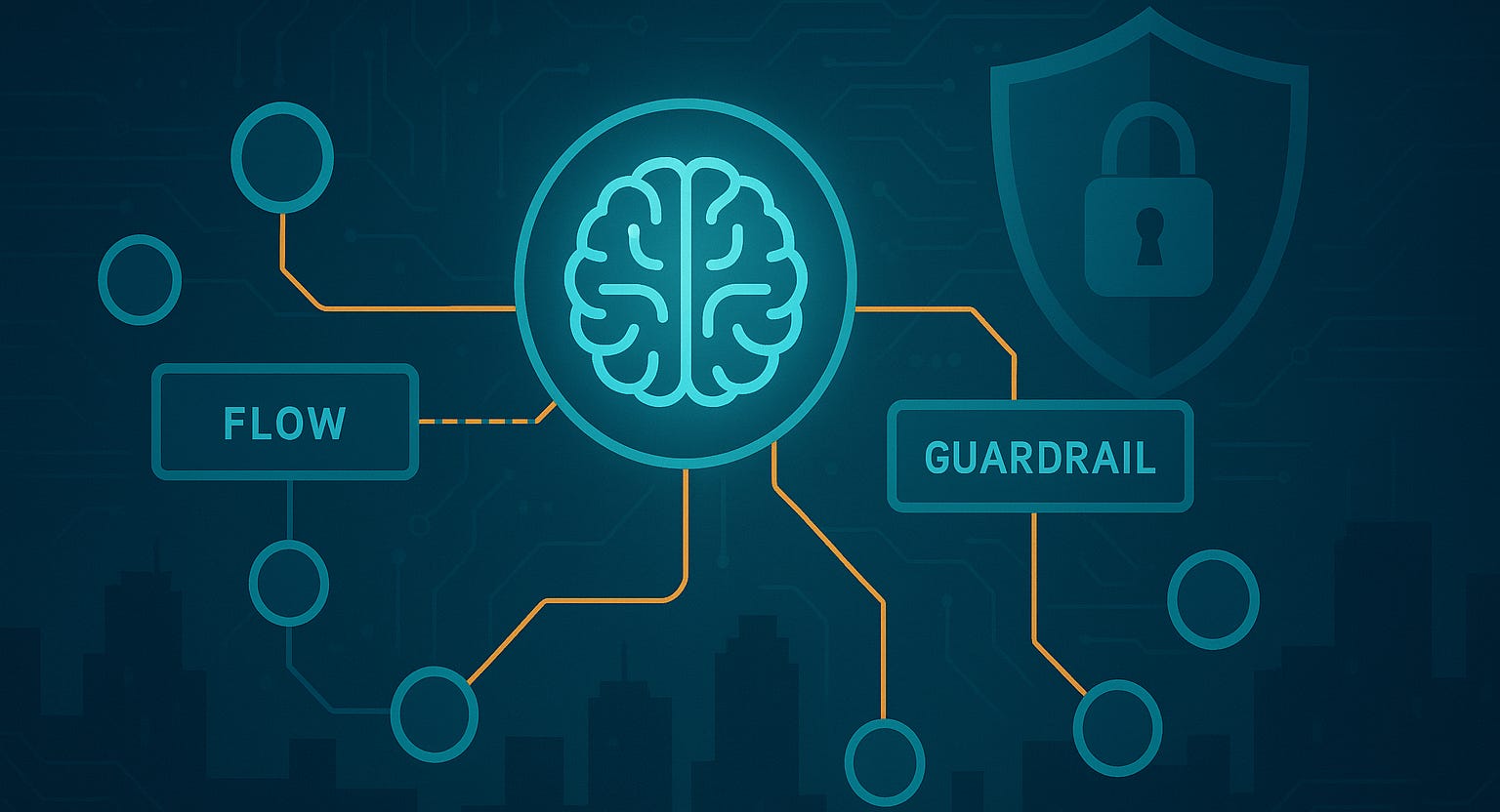
The Agentic Enterprise, Part 3
From Pilots to Production: Identity, Guardrails, and Scale
Getting agents out of the lab and into production isn’t a “bigger model” problem. It’s an identity and governance problem. You need three things to survive audit season:
Identity-first design, where agents are treated as real users with scoped access
Policy-as-code guardrails, so rules live in code instead of buried in prompts
Boring, predictable orchestration, so everyone can see what’s deterministic, what’s agent-driven, and where humans must approve
The organizations that win won’t be the ones with the flashiest demo. They’ll be the ones who can answer, in one line, “which agent did what, in which system, under which policy, and why,” then back it up with logs and metrics.
From “Cool Pilot” to “This Holds Up in an Audit”
By this point in the series:
Part 1 helped you pick the right class of work and set the autonomy slider.
Part 2 cleaned up your process reality and built a knowledge store your agents can trust.
Part 3 is where that prep either pays off or falls apart. In production, nobody cares that the prototype crushed it in a conference room. They care about four questions:
Who (or what) has access to what?
What policies apply, and where are they enforced?
How do we know it’s working as intended?
What happens when it doesn’t?
This is where the “agentic enterprise” either becomes an operating model or gets quietly deprioritized after a risk review.
The AI Trust Layer: Identity First, Not Model First
In most enterprises, machine identities already outnumber humans. Service accounts, APIs, microservices, and now agents are all hitting systems with credentials that look a lot like users.
If you keep treating agents as a side effect of “the model” instead of first-class identities, you’re building on sand.
Agents Are Users
Treat each agent like a junior hire:
One agent, one identity. No shared keys, no generic “LLM_SERVICE” account.
Start with least privilege. Read-only where you can, narrow write access where you must.
Manage the lifecycle: provision, rotate, expire. When a pilot ends, its credentials should not live forever in a random secrets store.
This is standard identity hygiene, pointed at a new population. The underlying IAM patterns already exist; agents are just the newest group of machine actors asking for access.
If you can’t point to where an agent’s identity is defined, what it can touch, and who owns it, you don’t have governance, you have vibes.
Policy-as-Code: Stop Hiding Rules in Prompts
Prompts are great for shaping behavior, terrible for enforcing rules.
“Never move money over $10,000” inside a system prompt is not a control. A real control is something you can test, version, and review with security.
That’s policy-as-code:
Centralize rules about who can call which tool, against which data, under which conditions.
Keep policies in versioned code so changes are reviewed and tested, not quietly edited in a prompt.
Let security and risk teams update policies without redeploying the agent itself.
In practice, that can look like:
Blocking any tool call that would send PII to external SaaS
Requiring approvals for high-value payments or credit adjustments
Denying actions outside business hours, or above certain thresholds, regardless of what the model “thinks”
The model can suggest an action. Policy decides whether it is allowed.
Designing for LLM-Specific Risk, Not Just Old AppSec
If you work in financial services or any regulated environment, you already live with frameworks and checklists. AI simply adds a new layer to that stack.
Two useful anchors:
Risk frameworks that talk about mapping use cases, identifying harms, and monitoring performance over time
Security guidance focused on LLM-specific issues like prompt injection, insecure output handling, and excessive autonomy
Those give you very practical questions:
Where could prompt injection show up in this flow?
How do we validate outputs before they touch a real system?
Where are we limiting the agent’s ability to chain tool calls together?
Regulation is catching up as well. Credit, fraud, AML, sanctions, and suitability decisions are all drifting into the “high-risk AI” bucket in various regimes, which means you need to be able to show your homework on oversight and controls.
“Good demo” is not a control.
Orchestrate Like an Engineer, Not a Demo Script
In Part 1, we talked about the autonomy spectrum. In production, that autonomy shows up as orchestration.
You’re mixing three things:
Deterministic steps, for policy checks, validation, and simple API calls
Agent loops, where the system can decide “what next?” and pick tools
Human-in-the-loop gates, where the risk is high enough that someone must approve
Good orchestration looks more like a process map than a clever prompt. You should be able to sketch it and point to:
“Here the agent is just a copilot, proposing drafts.”
“Here the agent can execute but only within guardrails.”
“Here we always pause, because it touches credit, money, or regulatory status.”
Frameworks for stateful agents and long-running flows are starting to bake this in: stored state, explicit HITL checkpoints, and observability. The framework you choose is less important than the discipline of separating:
Where the model is allowed to improvise
Where the system must be deterministic
Where a person is on the hook for the decision
Build, Buy, or Hybrid? Pick Your Battles
This is where the product brain kicks in: not every use case needs a bespoke platform.
A practical split:
Buy for horizontal, non-differentiating workflows
IT helpdesk, HR questions, generic knowledge search, internal productivity agents
Vendors and clouds are already opinionated here, and you’re buying speed and shared learning
Build for your crown jewels
Risk strategies, KYB/KYC orchestration, portfolio analytics, fraud patterns
This is where your data and logic are the moat, and you want custom orchestration with tight hooks into existing controls
Most organizations land in hybrid territory:
Use managed platforms for identity, logging, and plumbing
Layer on custom agents and flows where they actually move the needle
One design choice that pays off quickly: keep orchestration model-agnostic. Route cheap, frequent tasks to smaller models and sensitive or high-value work to higher-quality or private models. That should be a configuration change, not a rewrite.
Measuring More Than “Cost Saved”
If you measure this work poorly, it gets lumped into “innovation theater.” A simple way to keep it honest is to look through a few lenses instead of one big “ROI” slide.
You might track things like:
Efficiency: turnaround times, deflection rates, hours or tickets avoided
Quality and risk: rework, error rates, policy violations, SLA adherence
Adoption: how much of the target workflow actually runs through the agent, and what gets escalated back to humans
Strategic lift: time-to-market, new revenue opportunities, fewer audit findings or less busywork around compliance
Look, I know that list sounds like extra work. It is. But if you want budget and air cover for agents, you have to be able to show that something meaningful moved, not just that “the model was impressive.”
What “Production-Ready” Actually Looks Like
Think of this as table stakes. If any of these are missing, you are still in pilot mode, no matter what the slide says.
Identity and Access
One agent per identity, with scoped permissions
Human and machine identities managed with the same discipline
Automatic credential rotation and de-provisioning when agents or pilots are retired
Guardrails and Policy
Rules enforced in code before tool calls, not only in prompts
Clear allow-lists for tools, data domains, and sensitive actions
Contextual constraints: thresholds, geographies, time-of-day rules
LLM Safety Basics
Defenses against prompt injection baked into how you handle inputs and retrieval
Output validation and strict schemas before anything hits a real system
Comprehensive logging of retrieved context and tool calls for every run
Oversight and Compliance
Immutable run logs that show inputs, context, plans, tool calls, outputs, and approvals
High-risk flows mapped to your internal or external oversight standards
A clear answer to “where is the human in the loop, and what evidence do they see?”
If your design can’t show where each of those lives, it’s not production-ready yet. It’s still a very nice pilot.
Closing the Loop
This series started with a simple, uncomfortable observation: most failed “agent” efforts aren’t model failures. They’re work-selection and governance failures.
Part 1 argued that agents should start as smart interns, not rogue traders.
Part 2 argued that agents are only as good as the maps and knowledge you give them.
Part 3 argues that production success is about identity, guardrails, orchestration, and a habit of measuring what matters.
If you get those right, autonomy stops being a parlor trick and becomes something you can dial up or down based on evidence, not optimism.
Start narrow. Keep your logs. Let the controls, not the demo, decide when your agents graduate.